South Korea's Ministry of Foreign Affairs has pushed back against recent statements from North Korea and China that condemned Seoul's extended deterrence cooperation with the United States. The ministry stated on June 23 that such cooperation is a 'legitimate response' to North Korea's escalating illegal nuclear and missile programs, and a 'due obligation' for a responsible government to protect its citizens.
The ministry's spokesperson, Park Il, affirmed that the Republic of Korea (South Korea) is faithfully adhering to its obligations under the Nuclear Non-Proliferation Treaty (NPT) and remains committed to the international non-proliferation regime. This statement came in response to China's Ministry of Foreign Affairs expressing concerns on June 18 about the extended deterrence between South Korea and the U.S., as well as between the U.S. and Japan.
North Korea's state media, including the Rodong Sinmun and Korean Central News Agency, also criticized the Nuclear Consultative Group (NCG) meetings, a key forum for U.S.-South Korea extended deterrence discussions. North Korean leader Kim Jong Un reportedly stated that South Korea's pursuit of nuclear-powered submarines and the NCG's operations are pushing the Korean Peninsula toward a nuclear war, using this as justification for strengthening North Korea's nuclear and military capabilities. A South Korean foreign ministry official clarified that Seoul's development of nuclear-powered submarines is a defensive measure to bolster its security in response to the rapidly changing security environment on the peninsula, including North Korea's advanced nuclear and missile capabilities.
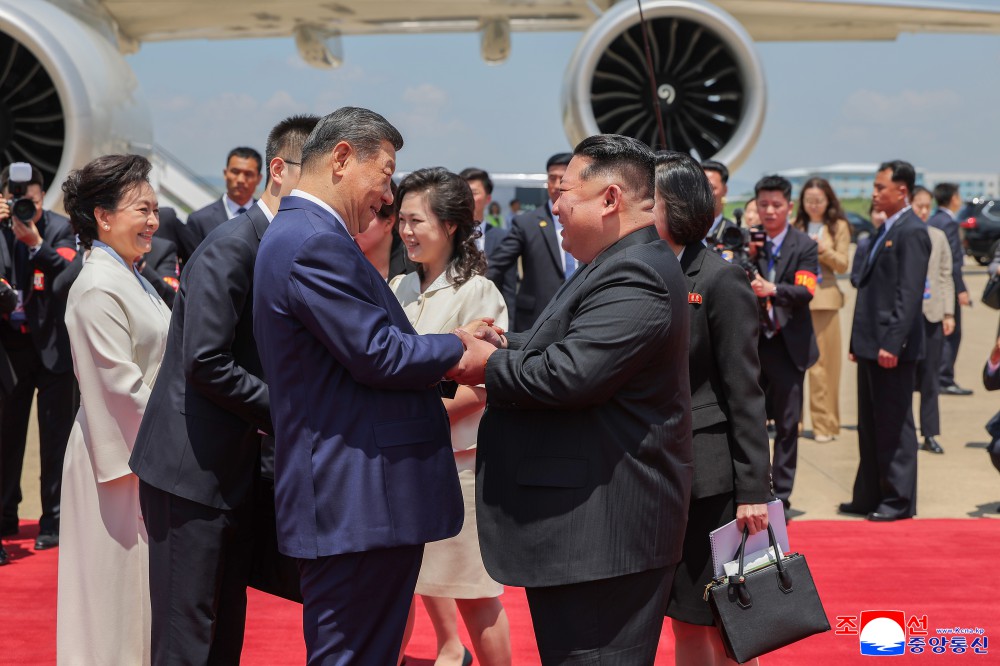
The joint criticism from Beijing and Pyongyang follows a summit in Pyongyang on June 8 between Kim Jong Un and Chinese President Xi Jinping, where the North Korean nuclear issue was not publicly addressed. Some analysts suggest that China might be tacitly condoning North Korea's nuclear status to draw Pyongyang into its strategic rivalry with the U.S., despite potential concerns about stimulating nuclear armament in Japan.
However, South Korean foreign and security authorities reportedly do not view North Korea's recent statements as a direct result of coordination with China, but rather as a continuation of its consistent opposition to U.S.-South Korea extended deterrence. While China has not explicitly mentioned North Korean denuclearization recently, Seoul notes Beijing's continued use of the phrase 'continuity of Korean Peninsula policy' and plans to persist in urging China to play a 'prudent and constructive role' in achieving denuclearization and regional peace and stability.