
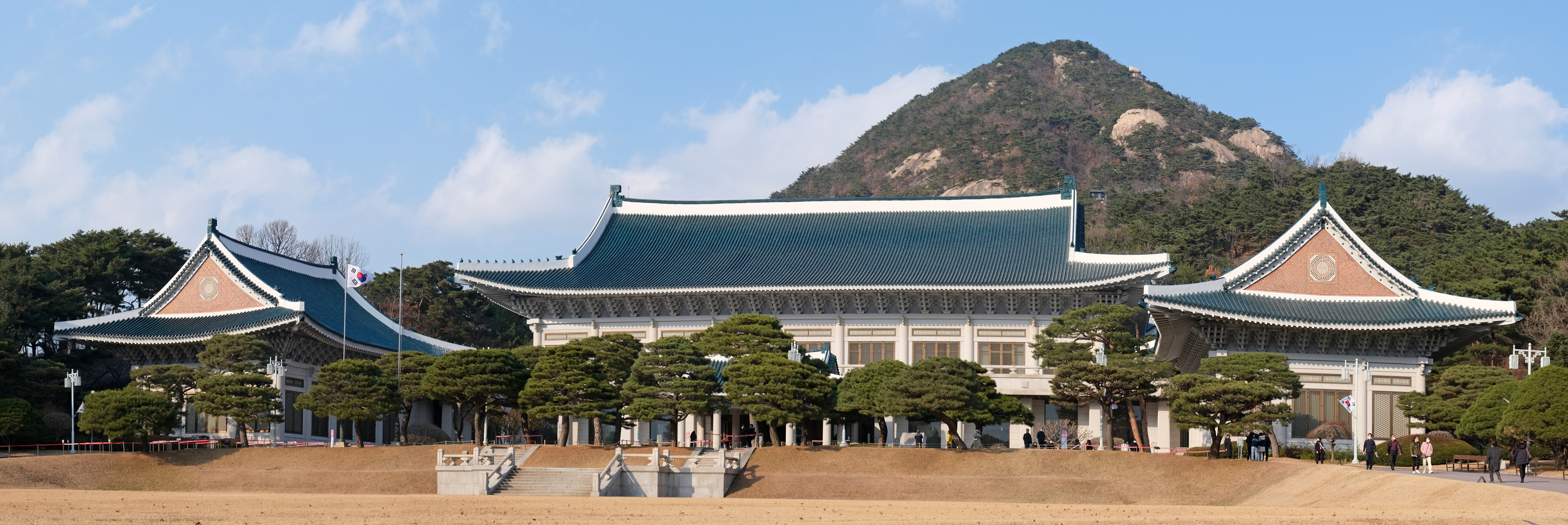
President Lee Jae-myung expressed profound gratitude to Samsung Electronics Chairman Lee Jae-yong and SK Group Chairman Chey Tae-won for their commitment to invest trillions of won in advanced industries, including semiconductors, AI, and data centers. During the 'Republic of Korea's Grand Leap 3 Mega Projects National Report Meeting' at Cheong Wa Dae on June 29, President Lee called the two business leaders 'national heroes' and bowed deeply to them, an act his chief of staff, Kang Hoon-sik, said was a genuine expression of thanks, preventing a full bow only at the urging of aides.
The government pledged comprehensive support for these investments, particularly in the southwestern region, promising 'one-stop administrative procedures' and ensuring timely provision of electricity and water. President Lee specifically mentioned the 'local production, local consumption' principle for electricity in the Gwangju-Jeollanam-do area to offer competitive rates. Kang Hoon-sik stated that the government aims to complete the southwestern semiconductor cluster within the current administration's term, targeting foundational construction within two years, drawing parallels to Japan's Kumamoto where a semiconductor factory was established in two years.
SK Group outlined a long-term investment plan of approximately 1,000 trillion won for AI data centers and 1,100 trillion won for semiconductor production. This includes establishing 15 GW of AI data centers across the country by 2035 and building an AI memory production belt connecting Yongin, Cheongju, and the southwestern region. SK Hynix plans to accelerate the completion of the Yongin Semiconductor Cluster by 12 years to 2033 and invest 100 trillion won in its Cheongju production base. The southwestern region is being considered for a future semiconductor production hub, with a potential investment of 400 trillion won.
Samsung Electronics also announced a total domestic investment of 2,655 trillion won, with 425 trillion won allocated to the Honam region for a semiconductor fabrication plant and a digital twin hub. The company plans to focus robot-related investments in Gumi, Gyeongsangbuk-do, and high-bandwidth memory (HBM) in Cheonan and Onyang.
However, these plans have drawn criticism from opposition parties and regional politicians. The People Power Party (PPP) accused the government of 'forcing' these investments in the Honam region, calling it 'state-led economic intervention' and a 'political decision' that could exacerbate regional divisions. They questioned the suitability of the Honam region's infrastructure, particularly regarding electricity and water supply, and called for a parliamentary investigation into the site selection process. Politicians from the Daegu-Gyeongbuk (TK) region, including Gyeongsangbuk-do Governor Lee Cheol-woo and Daegu Mayor-elect Choo Kyung-ho, argued that national strategic industry locations should be determined by industrial competitiveness and market principles, not political considerations. They expressed concern that a new fabrication plant in Gwangju-Jeollanam-do could weaken the existing industrial base in Daegu-Gyeongbuk.
In response, the Democratic Party of Korea (DPK) dismissed the criticism as 'malicious smear tactics' and 'outdated regionalism,' threatening legal action. They highlighted that Gwangju-Jeollanam-do had received the highest scores in a 2023 government competition for advanced industrial special zones but was excluded by the previous Yoon Suk-yeol administration. Yongin Mayor Lee Sang-il also criticised the government for delays in the Yongin Advanced System Semiconductor National Industrial Complex project, attributing them to 'indifference and neglect.'
To address the substantial power needs, estimated at 6.3 GW for the Gwangju semiconductor fabrication plant, the government is considering new nuclear power plant construction and extending the lifespan of existing ones, in addition to expanding renewable energy sources. Water supply, estimated at 650,000 tons per year for the Honam cluster, is also being planned through various dam resources and new pipelines. The government also aims to improve living conditions, including education, culture, and medical infrastructure, to attract and retain a skilled workforce, with a goal of training 100,000 semiconductor professionals in the southern region.