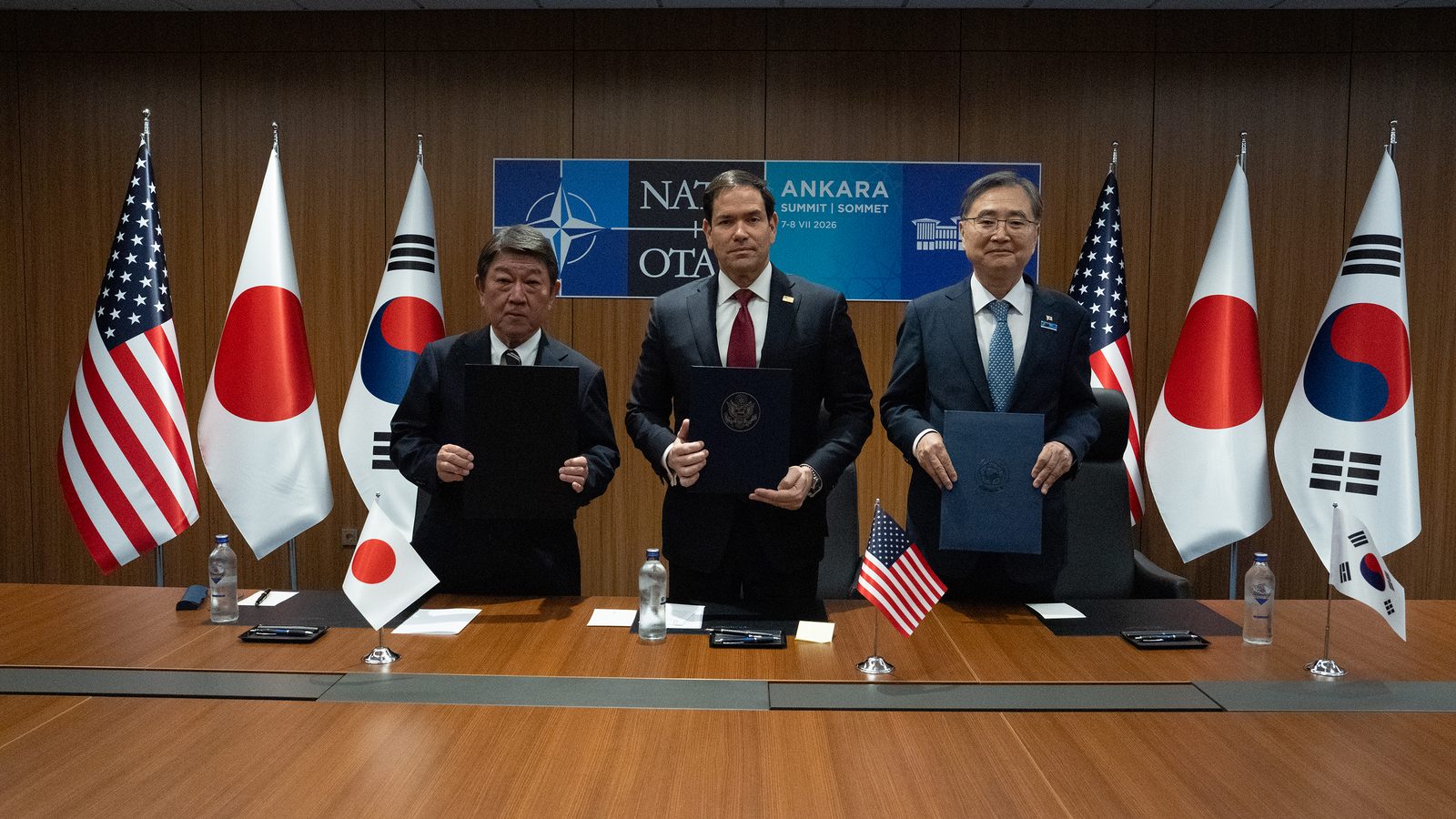
The foreign ministers of South Korea, the United States, and Japan signed a memorandum of cooperation (MOC) on July 7, on the sidelines of the NATO summit in Ankara, Turkiye, committing the three countries to a joint framework for deploying small modular reactors (SMRs) across the Indo-Pacific region.
Korea's Foreign Minister Cho Hyun, U.S. Secretary of State Marco Rubio, and Japan's Foreign Minister Motegi Toshimitsu put their signatures to the document at a trilateral foreign ministers' meeting held during the summit. The South Korean Ministry of Foreign Affairs and the U.S. State Department said the agreement targets Indo-Pacific nations as the primary beneficiaries, with the goal of accelerating reactor deployment.
The three governments described the pact as a chance for countries with complementary strengths in civilian nuclear power to encourage mutually beneficial cooperation among their industries. According to the joint statement, the framework aims to reduce project-development risk, achieve economies of scale, attract private investment, streamline licensing, and optimise supply chains. A coordinated trilateral approach, the statement said, would let companies from all three countries offer more competitive options to regional partners facing growing energy demand, while upholding top-tier standards on nuclear safety, security, and non-proliferation.
The MOC's specific provisions include support for building multiple SMR projects using standardised reactor designs and simplified contracting, formation of consortiums among the three countries' firms, financing and capacity-building assistance for recipient nations, and the supply of technology, fuel, equipment, and services.
To back the initiative, the Trump administration announced it would inject more than ten million dollars into the State Department's FIRST programme (Foundational Infrastructure for Responsible Use of SMR Technology), funding technical assistance and the establishment of a regional SMR training hub in the Indo-Pacific.
SBS News additionally reported that GE Vernova, Hitachi, Samsung C&T, and SGE have agreed on an industry-level initiative to advance deployment of the BWRX-300 SMR model across Europe, which the State Department said would support the MOC's objectives.
Rubio, speaking at the signing, called energy security 'one of the most important issues in the world today' and cited events in the Strait of Hormuz as a reminder of that reality. Cho said SMRs represent one of several areas where the three allies can 'work together to face the challenges of the world.' Motegi welcomed the outcome as a significant achievement building on previous trilateral cooperation.
The ministers also agreed to maintain close coordination on North Korea policy, including countering Pyongyang's alleged illicit cyber activities, and reaffirmed their commitment to Korean Peninsula denuclearisation through dialogue and diplomacy.