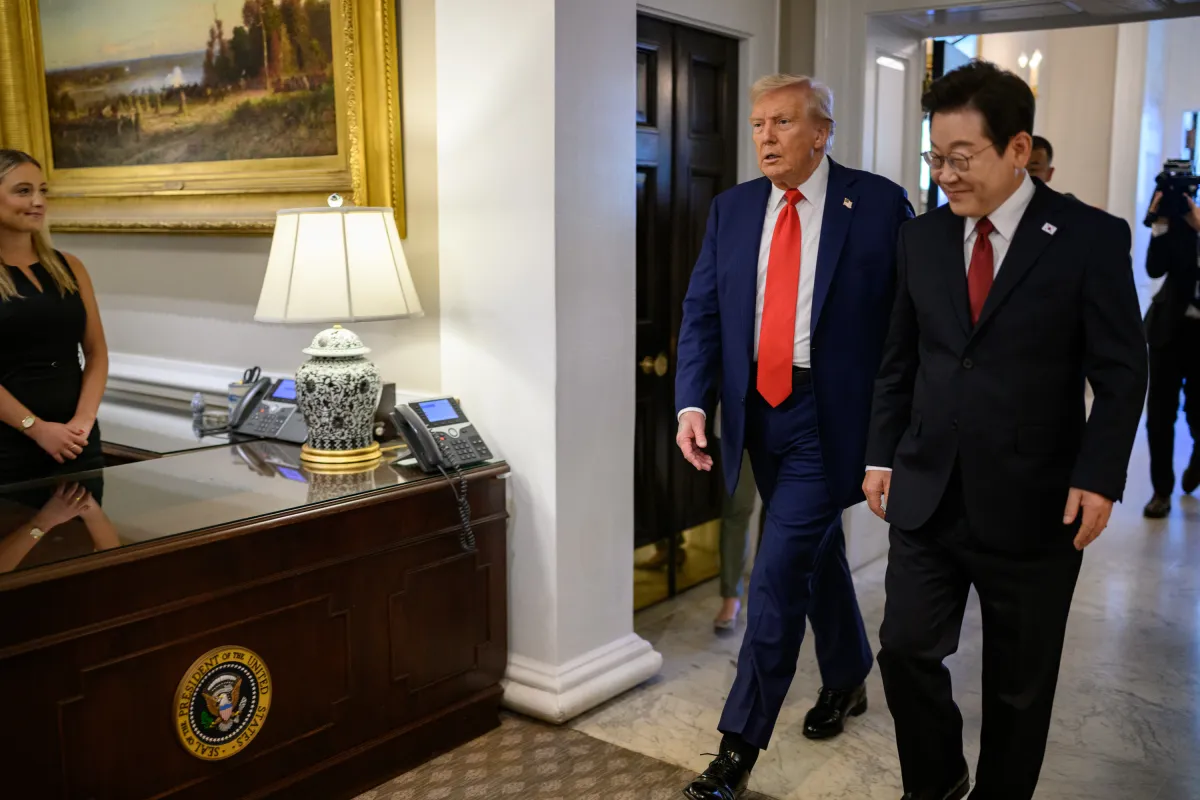
South Korea's presidential office said on July 9 that the United States appears open to having American military vessels built in South Korean shipyards, though much remains to be worked out before any such arrangement could take shape.
A senior Blue House official, briefing reporters in Ulaanbaatar during President Lee Jae-myung's state visit to Mongolia, said the administration had gained the impression that President Donald Trump 'has not ruled out construction in Korea.' The official added, however, that the precise form of any deal still needed clarification.
The backdrop: Trump first raised the idea at the G7 summit in Evian last month, asking Lee whether Korea could 'quickly build ten U.S. warships.' The two leaders returned to the subject briefly at the NATO summit dinner in Ankara on July 7, though the Blue House official described those exchanges as 'fragmented' conversations held standing at a banquet, not a systematic negotiation. American officials, pressed by events in the Middle East, had little time for detailed follow-up on the margins.
Several practical hurdles remain. U.S. law, including the Burns-Tollefson Act, generally prohibits building Navy vessels at foreign yards. The official noted that the president may have some executive room to maneuver and that Congress is also likely involved, but said it was still unclear whether Trump's request envisioned full hull construction or the so-called block-build method, in which modules are fabricated abroad and assembled domestically. The rules differ further depending on whether a vessel is a warship, a logistics support ship, or a quasi-commercial auxiliary.
Seoul is eager to engage. The official cited Korea's shipbuilding capabilities, existing bilateral investment discussions, and the MASGA (Korea-U.S. shipbuilding cooperation) framework as resources that could be combined to meet Washington's expectations. Further working-level talks between Seoul and Washington are planned after both delegations return home.
Separately, the official addressed U.S. State Department concern over Korea's revised Network Act, which took effect on July 7. The law requires platforms including Naver, Kakao, Google, Meta, and X to remove or block false and manipulated information, and imposes damages of up to five times actual losses for violations. The official said Korea would explain its position more thoroughly, characterizing the law as consumer protection rather than discriminatory treatment of foreign companies.